
Loma Linda Previous Residents Sources
Start with the current parcel, not a loose street-name guess. ARC Parcel Access can bridge a known Loma Linda address to an APN, owner-related name, situs details, and legal-description clues. Next, take that legal description and current owner to the San Bernardino County recorder index, which is party-based.
| Source | Years It Covers | Where Held | What It Shows |
|---|---|---|---|
| ARC Parcel Access | Current; valuation history 1978-present | ARC interactive search | APN, situs, mailing, values, legal-description clues |
| ARC recorder index | 1925-present on the general index page | Web index, Hall of Records, copy desk | Document number/date/title, grantor, grantee; no online image |
| ARC chain guide and microfilm | 1958-present online or office; pre-1958 microfilm | Main Recorder office and decade reels | Backward deed references and recording book/page/document data |
| County Historical Archives | Lot and parcel books, 1895-ca.1950 | County archive, access to confirm before travel | Owner or taxpayer, legal description, land and improvement values |
| Great Registers | 1866-1908 | County Historical Archives | Occupation, age, height, physical description, naturalization status |
| LLU local directories | 1924-1930; 1929 directory lead | LLU Heritage Research Center | Institutional contacts and a locality-based community lead |
| Federal population census | 1790-1950 released; 1950 newest public | NARA, libraries, genealogy databases | Household members, age, birthplace, occupation, address |
| County and city permit files | About 1936 forward where county jurisdiction applies | Building office, Community Development, or CPRA | Work dates, owner, applicant, contractor, scope, status |
Each source answers a different question. A deed connects parties to a parcel; a directory or census places people in a household at a moment. A permit dates a change but does not prove residence. Great Registers test an early name, not a household. Start with the era row, then use a second source to challenge it.
The San Bernardino County Assessor-Recorder-Clerk service directory routes the public to recorder, assessor, clerk, and archive services.
The ARC view anchors the trail to county land custodians.
Loma Linda Previous Residents: Address History
Write down the address exactly as known, then record the APN, legal description, situs, mailing address, and current owner-related name returned by Parcel Access. Property Info, Parcel History, and Owner History results help establish the parcel before a deed search begins. An APN is an assessor bridge, not a replacement for the formal legal description.
Situs means the physical place; mailing address means where tax correspondence goes. The two can differ, and the owner-derived name is not a complete resident list. Note the city, ZIP, tract, lot, and older address spelling before using the Loma Linda by-street directory workflow for current parcel context. Keep the legal description at every backward step.
Note: An assessor owner name is a property clue, not a complete list of people who lived at the address.
Loma Linda Previous Residents: Deed Chain
The ARC Property Research guide gives the local sequence: current owner to grantee index, legal-description match, deed grantor, earlier grantee, and repeat. Keep each recording date, document number, book, page, grantor, grantee, and legal match so a similar name cannot take over the chain.
The free recorder index shows document number, date, title, grantor, and grantee, but not images. Copies can be ordered online, by mail, or in person. Appointments are encouraged; mail normally takes one to two weeks. The research-time schedule listed $4 first page, $1.50 each additional page, $1.50 per certification page, and a 3.5% online card charge. Verify fees before ordering.
- Pull the current owner-related name, APN, and legal description from ARC Parcel Access. Save the result date and every legal-description fragment.
- Search that name as a grantee in the recorder index. Use date ranges and document types when a common name produces several candidates.
- Match the deed's legal description to the parcel, then record its grantor, book, page, document number, and recording date.
- Search the deed grantor as an earlier grantee. Confirm that the same tract, lot, block, or section description follows the seller backward.
- Repeat until the relevant era ends. Ask the main Recorder office for decade microfilm or deed-book help when the online path no longer reaches the needed record.
View contents at the San Bernardino Hall of Records or Hesperia High Desert Government Center; map copies are handled in San Bernardino. The index page says 1925-present, while the guide says 1958-present is online or in-office and pre-1958 indexes are microfilm. Preserve the discrepancy and confirm the route before promising a remote hit.
Loma Linda Previous Residents: Deed Records Glossary
Keep land terms separate from people terms. A recorded transfer identifies instrument parties, not every person who occupied the parcel.
- Grantor
- The person or entity conveying an interest in a recorded instrument, often the seller or prior owner.
- Grantee
- The person or entity receiving an interest, often the buyer or next owner in the chain.
- Chain of title
- The connected sequence of recorded transfers tied to one parcel through matching legal descriptions.
- Legal description
- The formal land identifier, such as a tract, subdivision, block, lot, or section-township-range description.
- Criss-cross directory
- A historical directory arranged around an address so a researcher can work from place to name; a verified Loma Linda run was not located.
An APN connects assessor and recorder, but it is not a legal description, street address, or deed. Copy an old tract or lot description exactly and ask how it maps to a later APN.
Loma Linda Previous Residents: Past Resident Records
Deeds show ownership parties. The household layer comes from directories, census schedules, newspapers, and institutional collections. The LLU Heritage Research Center lists Loma Linda Sanitarium and Hospital telephone directories for 1924-1930 and a 1929 “Loma Linda Citizen Directory by localities” record. These are local leads, not full scans or a complete Polk year run. Research access is at 11072 Anderson St., 909-558-4942, with appointment and visitor rules for outside researchers.
The federal census supplies a separate check. NARA's census access page identifies 1950 as the newest public census under the 72-year release rule. Schedules add household members, ages, birthplaces, occupations, and relationships, but address indexing and enumeration districts need care. No verified Loma Linda Sanborn sheet run was found.
Use the Loma Linda city directory collections material for shelf details; the address trail uses entries tied to the parcel, year, and household.
Note: A collection-level archive description proves a lead exists, not that a scanned page or full year run is online.
Loma Linda Directory Census Pairing
Pair a directory entry with a census year instead of treating either source as final proof. A directory may omit students, new subdivisions, rural routes, or people listed through another household member. The census adds relationships and ages, but a nearby address or shifted enumeration district may require a parcel check.
- Choose an anchor date from a deed, lot book, or permit and write each known street and occupant spelling.
- Find the nearest directory year. Copy name, spouse notation, occupation, address, and any “r” or “h” mark exactly.
- Open the matching released census through NARA, a library, or a genealogy database. Check household, ages, birthplace, occupation, and relationships.
- Compare stable clues, then test the address against the legal description, deed parties, or a later directory year.
- Mark an unresolved gap. It may reflect compilation practice, an address change, an unscanned volume, or archivist-only access.
The 1924-1930 telephone run and 1929 citizen-directory record are useful Loma Linda leads, but pages and entry fields require archive inspection. A collection lead is not proof of residence.
Loma Linda Record Era Gaps
For older land history, the County Historical Archives holds assessor lot and parcel books from 1895 to about 1950, arranged by school district and legal description. They may name an owner or taxpayer with tract, block, lot, or township, range, and section details. Improvement, tree, vine, and water values show change, not every person in a house.
The archive also holds Great Registers from 1866-1908, with occupation, age, height, physical description, and naturalization fields. It was listed closed during research, so email ARC-DLRecArchive@arc.sbcounty.gov or call 909-387-1001 before travel. Pre-1958 recorder work belongs at the main office's decade microfilm.
Loma Linda was Mound City in the 1880s, Adventists acquired the resort in 1905, and the city incorporated September 29, 1970. Earlier references may sit with county or institutional custodians.
Note: A gap can reflect custody, indexing, protected data, or an address change rather than an empty past.
County voter-record categories and maintenance guidance can provide a limited name cross-check, but California voter data is purpose-restricted and not an open street roll.
The voter source clarifies what may be requested and what remains protected.
Loma Linda Permit Records
Permit files can place a remodel, addition, or project in time and may name an owner, applicant, contractor, address, scope, and status. They show a project role, not continuous residence. County permits are about 1936 forward where county jurisdiction applies. After incorporation in 1970, city coverage depends on the department and record series.
Loma Linda Community Development routes planning, zoning, building, code, and permit material; its posted counter is 8:00-10:00 a.m. Monday-Thursday, Friday closed, appointment recommended, with planning at 909-799-2830. The City Clerk can route council and administrative records: Lynette Arreola, 909-799-2819, larreola@lomalinda-ca.gov, City Hall, 25541 Barton Road, posted Monday-Thursday 7:00 a.m.-5:30 p.m.
The Loma Linda public-records request form asks for an address, specific record description, and date range. It states a ten-calendar-day initial determination, a possible 14-working-day extension, typical two-to-four-week fulfillment, free electronic copies, and $0.25-$3 per-page direct duplication.
Describe the APN, permit type, date span, project scope, and names or roles sought. Ask for an existing record.
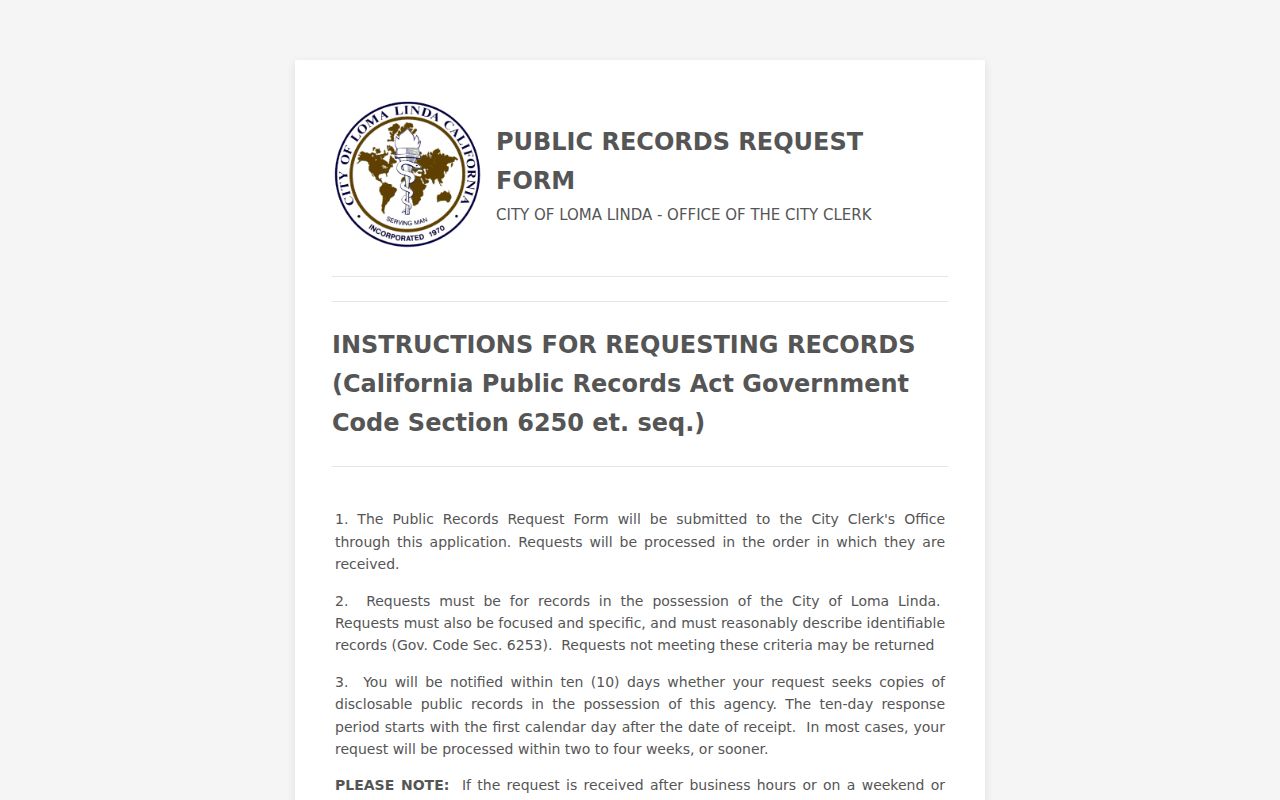
The capture shows the address and record-description fields needed for routing.
Loma Linda Past Residents Endpoints
Obituaries, cemetery records, and probate can close a household trail after a person leaves an address or dies. County probate proceedings from 1853-1926 are held through the Historical Archives and may include a will, fiduciary, debts, taxes, distribution, spouse, children, and notice addresses. Later probate metadata can begin in the San Bernardino Superior Court Access Portal, although older court data is limited and some files are off-site or restricted.
Read a docket as chronology, not a life story. It may show case number, filing date, type or status, parties, courthouse, hearings, register events, and document links. A filing address may belong to counsel, and an allegation is not a finding. Use a probate caption, notice, distribution order, obituary, or cemetery record to confirm identity, then compare the deed chain and directory years. Probate may connect a deceased owner to heirs; an obituary or institutional record may better identify a non-owner past resident.
Loma Linda Previous Residents House History
A careful address history ends with verification, not a list of living people. Deed-copy notices, unexpected filings, and payment demands can be part of a real-estate scam. Compare an alert with the recorder document number and the custodian's independent contact information.
When an earlier household member may use California's Safe at Home program, a public address trail can be intentionally incomplete. Government Code sections 6205 and following and section 6209.5 support a confidential-address program with a designated mailing route. The Secretary of State's Safe at Home FAQ explains the program; treat a missing address as a privacy boundary, not evidence that the person never lived there.
The linked state guidance is a privacy-protection reference, not a way to uncover a protected address.
The California bizfile guidance is a separate affiliation route when an old name is connected to an entity rather than a household.
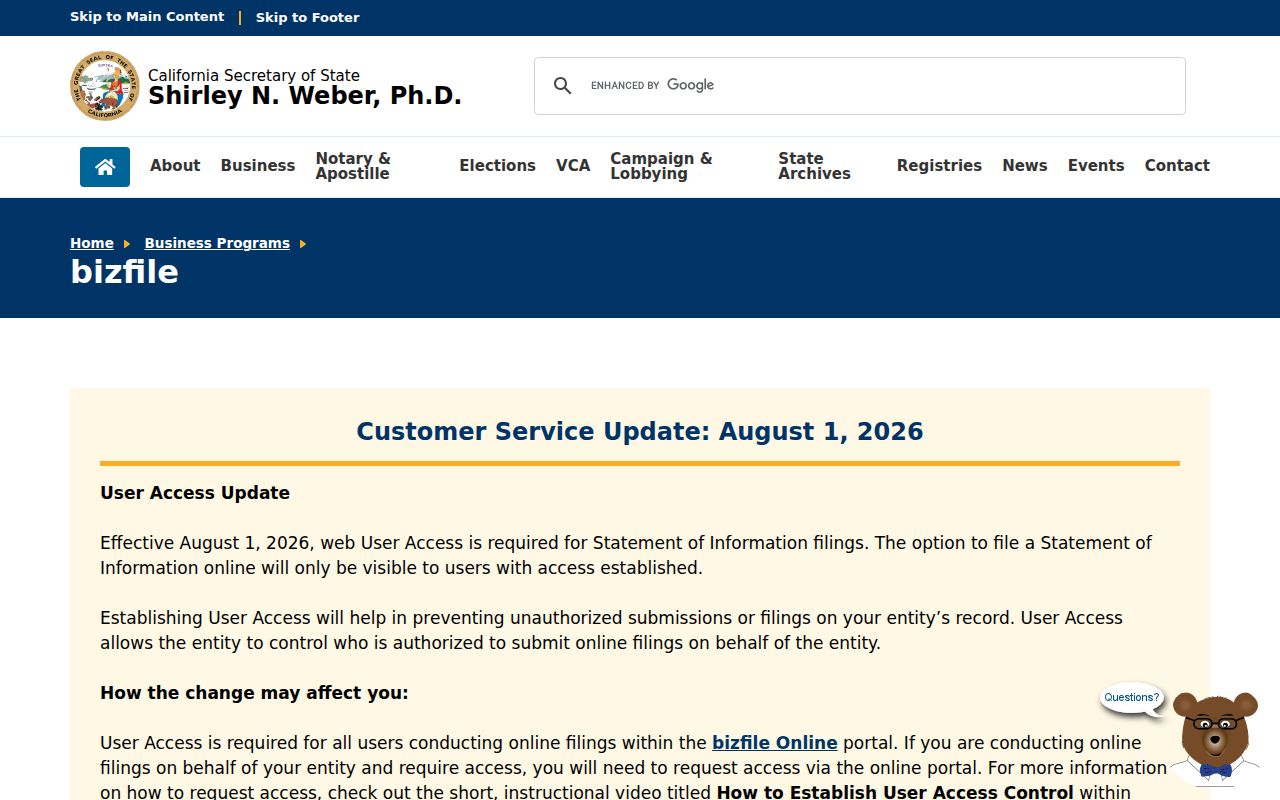
The bizfile source can help distinguish a business filing from a residence; the deed chain remains the land record.
The San Bernardino County District Attorney's real-estate-fraud resource explains that ARC and the DA automatically mail a prior owner an informational letter with the first two pages for listed deed or default filings. An unexpected filing can be reported to realestate@sbcda.org through the county process.
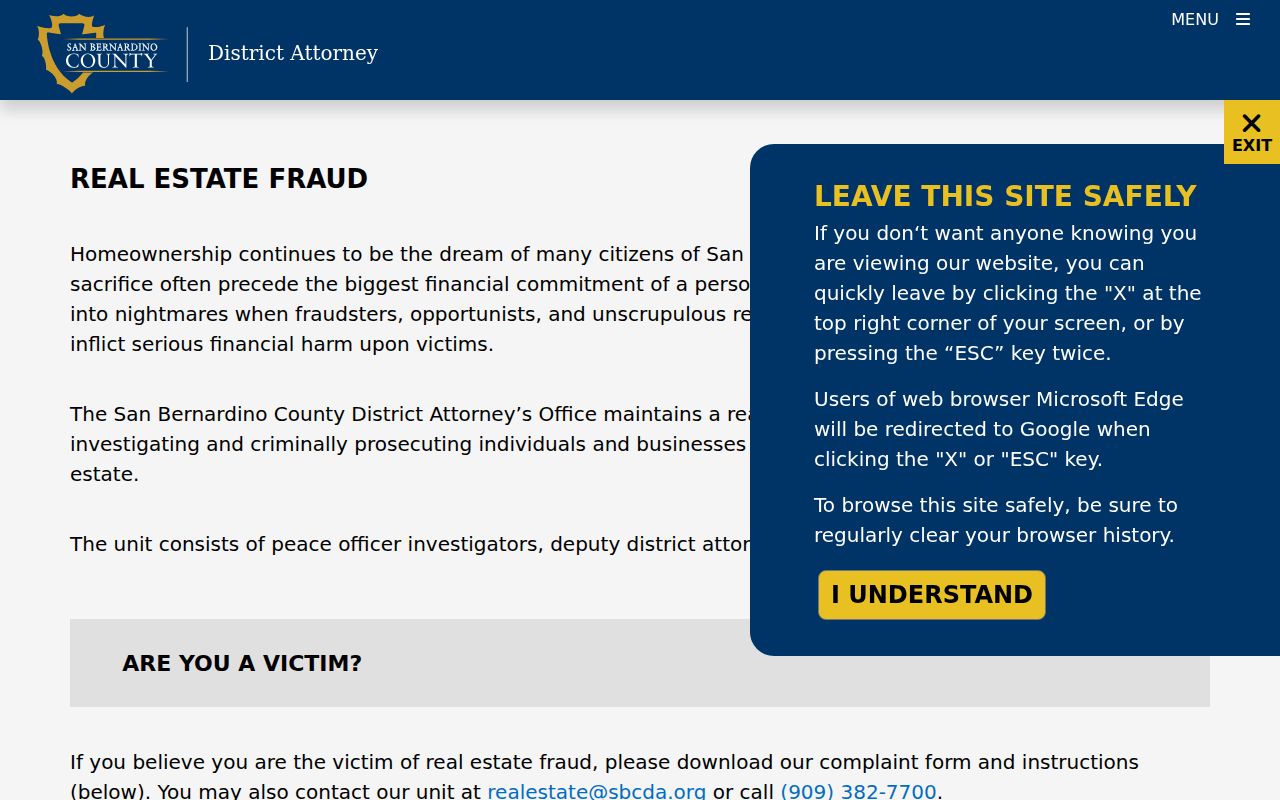
The DA source adds a local scam check.
Lawful house history. Previous-resident research is appropriate for genealogy, family history, archival study, and checking a deed. Do not use names, addresses, or images to follow, frighten, or harass a living person. Public availability does not remove California's anti-stalking and harassment limits.